OpenTelemetry traces
ElevenLabs Agents can export conversations as OpenTelemetry traces encoded as OTLP JSON (resourceSpans). Forward them to Datadog, Grafana Tempo, Honeycomb, or any backend that ingests OTLP.
Overview
Section titled “Overview”Export traces from three surfaces. All three share the same trace ID per conversation and elevenlabs.* attribute naming. Span shape and timing differ between post-call/GET (transcript-based) and monitoring (event-based).
Export surfaces
Section titled “Export surfaces”| Surface | When you get data | Best for |
|---|---|---|
| Post-call webhook | After the conversation ends and analysis completes | Batch pipelines, billing and QA, durable storage |
| GET conversation API | On demand, after the conversation exists | Backfill, debugging, re-processing |
| Monitoring WebSocket | During a live conversation | Live dashboards, alerting, human-in-the-loop |
Choosing a surface
Section titled “Choosing a surface”- Every completed call in your data warehouse: post-call webhook
- One-off export or repair: GET conversation with
format=opentelemetry - Live supervisor UI or alerting: monitoring WebSocket
- Full fidelity timeline after the fact: post-call webhook or GET conversation
- Tool, MCP, or guardrail events as they happen: monitoring WebSocket
Use traceId or elevenlabs.conversation_id to join data across surfaces. Combine monitoring for live operations, webhooks for durable analytics, and GET for backfill.
You need an OTLP-capable collector or observability vendor for every surface. Post-call webhooks require a workspace webhook endpoint. The GET API and monitoring WebSocket each have their own API key scopes and setup; see the sections below.
Post-call webhook
Section titled “Post-call webhook”After a conversation finishes, ElevenLabs sends a POST request when a post-call webhook is configured, events includes transcript, and transcript_format is opentelemetry.
The webhook type is post_call_transcription_otel (not post_call_transcription, which returns JSON transcripts).
Webhook payload
Section titled “Webhook payload”{
"type": "post_call_transcription_otel",
"event_timestamp": 1700000000,
"data": {
"conversation_id": "conv_9001k1zph3fkeh5s8xg9z90swaqa",
"agent_id": "agent_7101k5zvyjhmfg983brhmhkd98n6",
"otlp_traces": {
"resourceSpans": []
}
}
}Enable OpenTelemetry transcripts
Section titled “Enable OpenTelemetry transcripts”Configure via the dashboard
Section titled “Configure via the dashboard”Create a workspace webhook
Section titled “Create a workspace webhook”In the ElevenAgents Dashboard, create a workspace webhook with your HTTPS URL and authentication.
Attach the post-call webhook
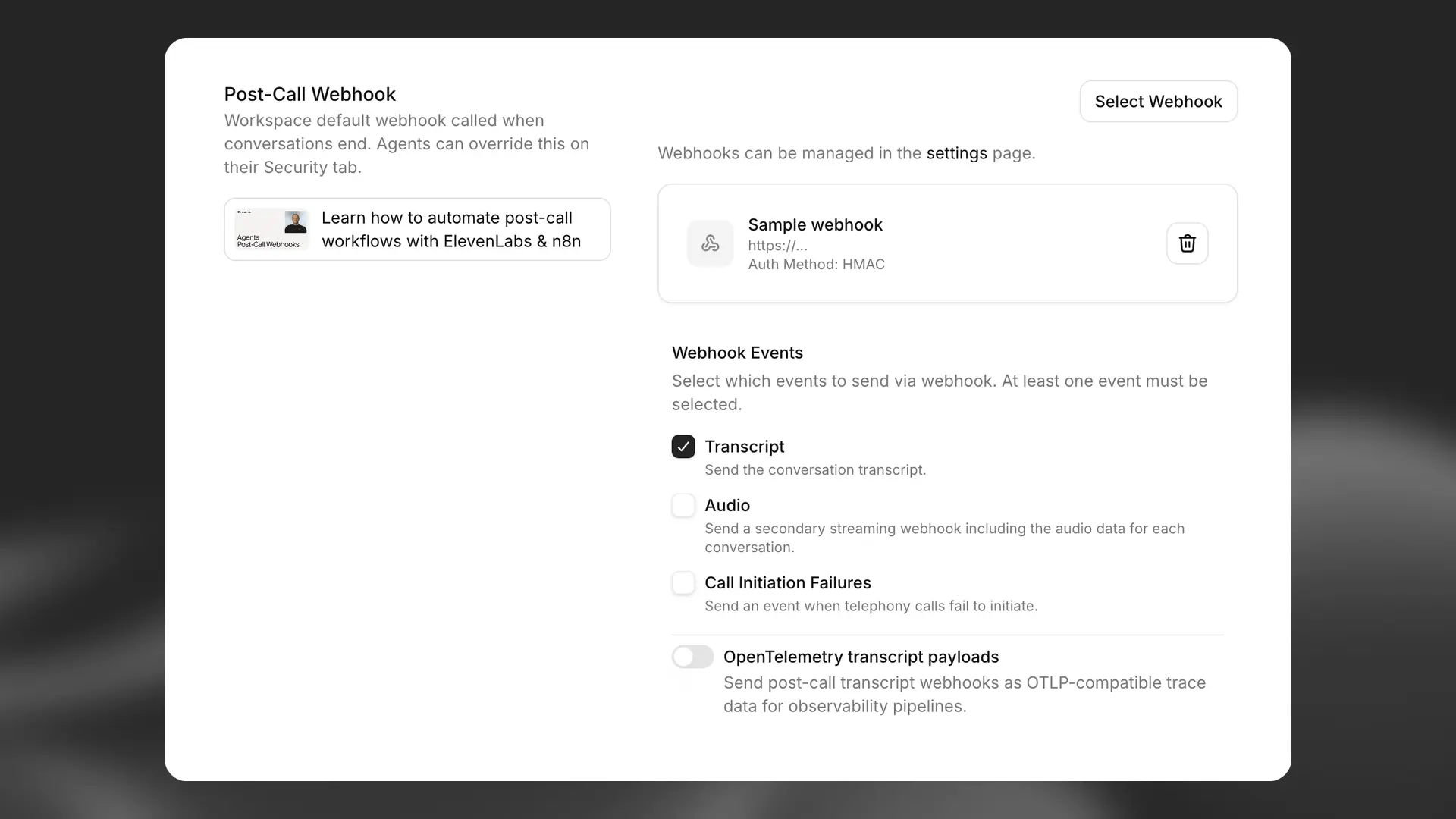
Section titled “Attach the post-call webhook”Open Agents settings, assign the webhook as the post-call webhook, enable the Transcript event, and turn on OpenTelemetry transcript payloads.
Configure via the CLI
Section titled “Configure via the CLI”Pull the agent configuration
Section titled “Pull the agent configuration”elevenlabs agents pull --agent "<agent-name>"Edit agent_configs/<agent-name>.json
Section titled “Edit agent_configs/<agent-name>.json”Set platform_settings.workspace_overrides.webhooks:
{
  "platform_settings": {
    "workspace_overrides": {
      "webhooks": {
        "post_call_webhook_id": "wh_01jqz7x8y9z0a1b2c3d4e5f6",
        "events": ["transcript"],
        "transcript_format": "opentelemetry"
      }
    }
  }
}
Push your changes
Section titled “Push your changes”elevenlabs agents push --agent "<agent-name>"Configure via the API
Section titled “Configure via the API”Python
import os

from dotenv import load_dotenv
from elevenlabs import ElevenLabs

load_dotenv()
elevenlabs = ElevenLabs(api_key=os.getenv("ELEVENLABS_API_KEY"))

elevenlabs.conversational_ai.settings.update(
    webhooks={
        "post_call_webhook_id": "wh_01jqz7x8y9z0a1b2c3d4e5f6",
        "events": ["transcript"],
        "transcript_format": "opentelemetry",
    },
)
TypeScript
import { ElevenLabsClient } from "@elevenlabs/elevenlabs-js";

const elevenlabs = new ElevenLabsClient({
  apiKey: process.env.ELEVENLABS_API_KEY,
});

await elevenlabs.conversationalAi.settings.update({
  webhooks: {
    postCallWebhookId: "wh_01jqz7x8y9z0a1b2c3d4e5f6",
    events: ["transcript"],
    transcriptFormat: "opentelemetry",
  },
});
For a single agent, pass the same webhooks object under platform_settings.workspace_overrides in Update agent.
Delivery
Section titled “Delivery”| Topic | Detail |
|---|---|
| Method | POST with JSON body |
| Auth | ElevenLabs-Signature: t={unix},v0={hmac} over {timestamp}.{body} |
| Retries | Transcript webhooks only; requires Enable retries on the webhook; see warning above |
| Size | Long tool parameters and results truncate at 4 KB per span attribute |
Trace shape
Section titled “Trace shape”Each delivery is one complete trace: a root span plus children.
elevenlabs.conversation
├── elevenlabs.recv.user_transcript
├── elevenlabs.recv.agent_response
│   └── elevenlabs.tool.{name}
└── ...
Agent-response spans include elevenlabs.reasoning_content when the delivery contains a reasoning summary.
Timing comes from transcript time_in_call_secs and call metadata. The root span sets elevenlabs.source = post_call_webhook and status ERROR when the call did not end with a normal client disconnect.
GET conversation
Section titled “GET conversation”Request OpenTelemetry format on Get conversation to receive the same otlp_traces object as the post-call OpenTelemetry webhook, plus the full conversation model.
GET /v1/convai/conversations/{conversation_id}?format=opentelemetryRequires an API key with CONVAI_READ. With format=json (default), otlp_traces is omitted.
{
  "conversation_id": "conv_9001k1zph3fkeh5s8xg9z90swaqa",
  "agent_id": "agent_7101k5zvyjhmfg983brhmhkd98n6",
  "status": "done",
  "transcript": [],
  "otlp_traces": {
    "resourceSpans": []
  }
}| Topic | Detail |
|---|---|
| Timing | Same transcript-based builder as the post-call webhook |
| Transcript | transcript is still returned; otlp_traces is additive |
| File URLs | Signed URLs in span attributes expire after about 15 minutes |
Python
import os

from dotenv import load_dotenv
from elevenlabs import ElevenLabs

load_dotenv()
elevenlabs = ElevenLabs(api_key=os.getenv("ELEVENLABS_API_KEY"))

conversation = elevenlabs.conversational_ai.conversations.get(
    conversation_id="conv_9001k1zph3fkeh5s8xg9z90swaqa",
    format="opentelemetry",
)

otlp_traces = conversation.otlp_traces
TypeScript
import { ElevenLabsClient } from "@elevenlabs/elevenlabs-js";

const elevenlabs = new ElevenLabsClient({
  apiKey: process.env.ELEVENLABS_API_KEY,
});

const conversation = await elevenlabs.conversationalAi.conversations.get({
  conversationId: "conv_9001k1zph3fkeh5s8xg9z90swaqa",
  format: "opentelemetry",
});

const otlpTraces = conversation.otlpTraces;
cURL
curl -s "https://api.elevenlabs.io/v1/convai/conversations/conv_9001k1zph3fkeh5s8xg9z90swaqa?format=opentelemetry" \
  -H "xi-api-key: $ELEVENLABS_API_KEY" \
  | jq '.otlp_traces.resourceSpans[0].scopeSpans[0].spans[].name'
Expected span names include elevenlabs.conversation, elevenlabs.recv.user_transcript, and elevenlabs.recv.agent_response.
Monitoring WebSocket
Section titled “Monitoring WebSocket”Stream OpenTelemetry trace data as OTLP JSON while a conversation is in progress. Each message is a small resourceSpans batch, not one end-of-call trace.
wss://api.elevenlabs.io/v1/convai/conversations/{conversation_id}/monitor?events_format=opentelemetryAuthentication requires CONVAI_WRITE, xi-api-key (or Authorization), and EDITOR access on the agent workspace. Connect after the conversation starts.
Enable monitoring on the agent
Section titled “Enable monitoring on the agent”Set monitoring_enabled: true and configure monitoring_events before the call. See Real-time monitoring.
Connect with OpenTelemetry format
Section titled “Connect with OpenTelemetry format”Append events_format=opentelemetry to the monitoring WebSocket URL.
Session protocol
Section titled “Session protocol”- Connect with authentication headers.
- Receive
{"type": "connected"}. - Receive a root span batch (
elevenlabs.conversation,elevenlabs.source=monitoring). - Receive cached history (around the last 100 events), then
{"type": "history_complete"}. - Receive live span batches as events occur.
With events_format=json (default), the WebSocket returns raw client events instead of resourceSpans. Control commands match Real-time monitoring.
Trace shape
Section titled “Trace shape”elevenlabs.conversation
├── elevenlabs.turn.0
│ ├── elevenlabs.event.user_transcript
│ └── elevenlabs.tool.{name}
└── elevenlabs.turn.1| Aspect | Post-call and GET | Monitoring |
|---|---|---|
| Granularity | One trace per webhook or request | Many messages per conversation |
| Event spans | Transcript turns | elevenlabs.event.{type} |
| Turn grouping | Implicit in transcript order | Explicit elevenlabs.turn.N |
| Order | Stable transcript order | Events may arrive out of strict chronological order |
Structured events map to dedicated attributes (for example elevenlabs.user.text, elevenlabs.agent.text). Unknown events use elevenlabs.event.data with truncated JSON.
Example connection
Section titled “Example connection”TypeScript
import WebSocket from "ws";

const ws = new WebSocket(
  "wss://api.elevenlabs.io/v1/convai/conversations/conv_9001k1zph3fkeh5s8xg9z90swaqa/monitor?events_format=opentelemetry",
  {
    headers: {
      "xi-api-key": process.env.ELEVENLABS_API_KEY!,
    },
  }
);

ws.on("message", (raw) => {
  const msg = JSON.parse(raw.toString());
  if (msg.type === "connected" || msg.type === "history_complete") return;

  if (msg.resourceSpans) {
    forwardToCollector({ resourceSpans: msg.resourceSpans });
  }
});
Python
import asyncio
import json
import os

import websockets
from dotenv import load_dotenv

load_dotenv()

async def monitor_opentelemetry():
    uri = (
        "wss://api.elevenlabs.io/v1/convai/conversations/conv_9001k1zph3fkeh5s8xg9z90swaqa/monitor"
        "?events_format=opentelemetry"
    )
    headers = {"xi-api-key": os.getenv("ELEVENLABS_API_KEY")}

    async with websockets.connect(uri, extra_headers=headers) as ws:
        async for raw in ws:
            msg = json.loads(raw)
            if msg.get("type") in ("connected", "history_complete"):
                continue
            if msg.get("resourceSpans"):
                forward_to_collector({"resourceSpans": msg["resourceSpans"]})

asyncio.run(monitor_opentelemetry())
OTLP JSON structure
Section titled “OTLP JSON structure”OpenTelemetry traces from all surfaces share the same OTLP JSON batch layout:
{
  "resourceSpans": [
    {
      "resource": {
        "attributes": [
          { "key": "service.name", "value": { "stringValue": "elevenlabs-convai" } },
          {
            "key": "elevenlabs.conversation_id",
            "value": { "stringValue": "conv_9001k1zph3fkeh5s8xg9z90swaqa" }
          }
        ]
      },
      "scopeSpans": [
        {
          "scope": { "name": "elevenlabs.convai", "version": "1.0.0" },
          "spans": [
            {
              "traceId": "32_hex_chars",
              "spanId": "16_hex_chars",
              "name": "elevenlabs.recv.agent_response",
              "startTimeUnixNano": "1700000000000000000",
              "endTimeUnixNano": "1700000001000000000",
              "status": { "code": 1 }
            }
          ]
        }
      ]
    }
  ]
}
Limitations
Section titled “Limitations”- No direct push to your OTLP gRPC endpoint.
- Payloads are JSON shaped like OTLP export, not raw protobuf on the wire.