Success evaluation
Define custom criteria to assess conversation quality, goal achievement, and customer satisfaction.
Success evaluation allows you to define custom goals and success metrics for your conversations. Each criterion is evaluated against the conversation transcript and returns a result of success, failure, or unknown, along with a detailed rationale.
https://www.youtube-nocookie.com/embed/hvuuRpvAlV0?rel=0
Overview
Section titled “Overview”Success evaluation uses LLM-powered analysis to assess conversation quality against your specific business objectives. This enables systematic performance measurement and quality assurance across all customer interactions.
How it works
Section titled “How it works”Each evaluation criterion analyzes the conversation transcript using a custom prompt and returns:
- Result:
success,failure, orunknown - Rationale: Detailed explanation of why the result was chosen
Types of evaluation criteria
Section titled “Types of evaluation criteria”Goal prompt criteria pass the conversation transcript along with a custom prompt to an LLM to verify if a specific goal was met. This is the most flexible type of evaluation and can be used for complex business logic.
Examples:
- Customer satisfaction assessment
- Issue resolution verification
- Compliance checking
- Custom business rule validation
Configuration
Section titled “Configuration”Access agent settings
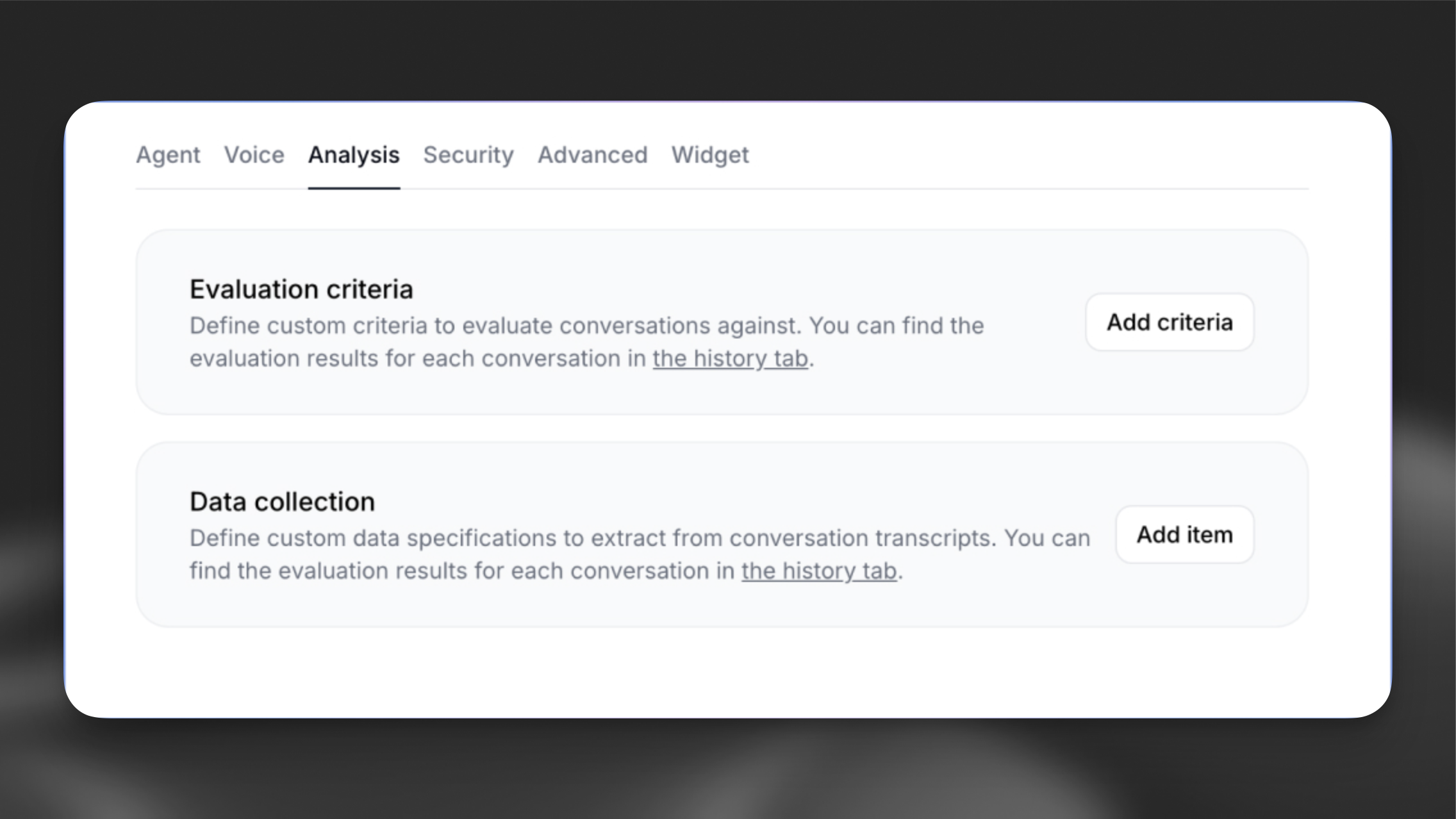
Navigate to your agent’s dashboard and select the Analysis tab to configure evaluation criteria.
Add evaluation criteria
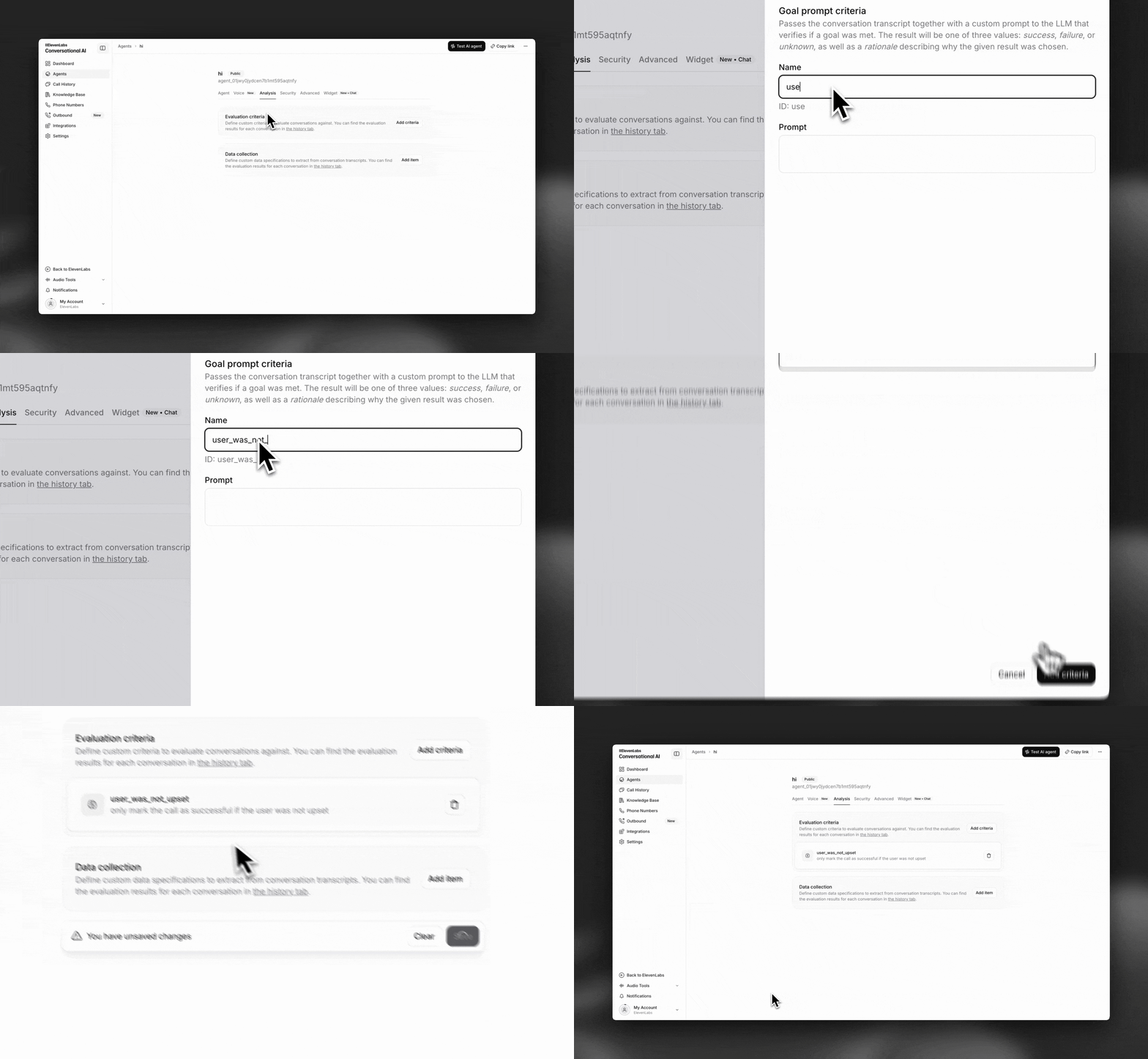
Click Add criteria to create a new evaluation criterion.
Define your criterion with:
- Identifier: A unique name for the criterion (e.g.,
user_was_not_upset) - Description: Detailed prompt describing what should be evaluated
- Identifier: A unique name for the criterion (e.g.,
View results
After conversations complete, evaluation results appear in your conversation history dashboard. Each conversation shows the evaluation outcome and rationale for every configured criterion.

Best Practices
Section titled “Best Practices”Writing effective evaluation prompts
- Be specific about what constitutes success vs. failure
- Include edge cases and examples in your prompt
- Use clear, measurable criteria when possible
- Test your prompts with various conversation scenarios
Common evaluation criteria
- Customer satisfaction: “Mark as successful if the customer expresses satisfaction or their issue was resolved” - Goal completion: “Mark as successful if the customer completed the requested action (booking, purchase, etc.)” - Compliance: “Mark as successful if the agent followed all required compliance procedures” - Issue resolution: “Mark as successful if the customer’s technical issue was resolved during the call”
Handling ambiguous results
The unknown result is returned when the LLM cannot determine success or failure from the transcript. This often happens with:
- Incomplete conversations
- Ambiguous customer responses
- Missing information in the transcript
Monitor unknown results to identify areas where your criteria prompts may need refinement.
Use Cases
Section titled “Use Cases”Customer Support Quality
Measure issue resolution rates, customer satisfaction, and support quality metrics to improve service delivery.
Sales Performance
Track goal achievement, objection handling, and conversion rates across sales conversations.
Compliance Monitoring
Ensure agents follow required procedures and capture necessary consent or disclosure confirmations.
Training & Development
Identify coaching opportunities and measure improvement in agent performance over time.
Troubleshooting
Section titled “Troubleshooting”Evaluation criteria returning unexpected results
- Review your prompt for clarity and specificity
- Test with sample conversations to validate logic
- Consider edge cases in your evaluation criteria
- Check if the transcript contains sufficient information for evaluation
High frequency of 'unknown' results
- Ensure your prompts are specific about what information to look for - Consider if conversations contain enough context for evaluation - Review transcript quality and completeness - Adjust criteria to handle common edge cases
Performance considerations
- Each evaluation criterion adds processing time to conversation analysis
- Complex prompts may take longer to evaluate
- Consider the trade-off between comprehensive analysis and response time
- Monitor your usage to optimize for your specific needs