Hosted MCP server
Create and manage your agents from Claude and other MCP clients.
https://www.youtube-nocookie.com/embed/EtT3UiXBzuc?rel=0
Overview
Section titled “Overview”The ElevenLabs hosted MCP server is a remote Model Context Protocol (MCP) server that exposes agent management tools to AI assistants. Once connected, an assistant such as Claude can create, configure, and manage the agents in your workspace through natural language, with nothing to install or run locally.
The server is available at:
https://api.elevenlabs.io/v1/mcpAuthentication uses OAuth. When you connect, you sign in with your ElevenLabs account and grant the assistant scoped access to your workspace. No API keys are copied into the client.
Connect from Claude Desktop
Section titled “Connect from Claude Desktop”The hosted MCP server is published in the Claude Desktop directory.
Open the directory
In Claude Desktop, go to Settings > Connectors and browse the directory.
Add the ElevenLabs connector
Search for ElevenLabs and select Connect.
Sign in
Complete the OAuth flow with your ElevenLabs account. Claude can then list, create, and update agents in your workspace on your behalf.
Data residency regions
Section titled “Data residency regions”The connector in the Claude directory and the default server URL connect to the global environment. If your workspace is in an isolated data residency environment, add a custom connector that points at your region’s URL instead:
| Region | MCP server URL |
|---|---|
| EU | https://api.eu.residency.elevenlabs.io/v1/mcp |
| India | https://api.in.residency.elevenlabs.io/v1/mcp |
| Singapore | https://api.sg.residency.elevenlabs.io/v1/mcp |
Add a custom connector in Claude
Section titled “Add a custom connector in Claude”Open the connector menu
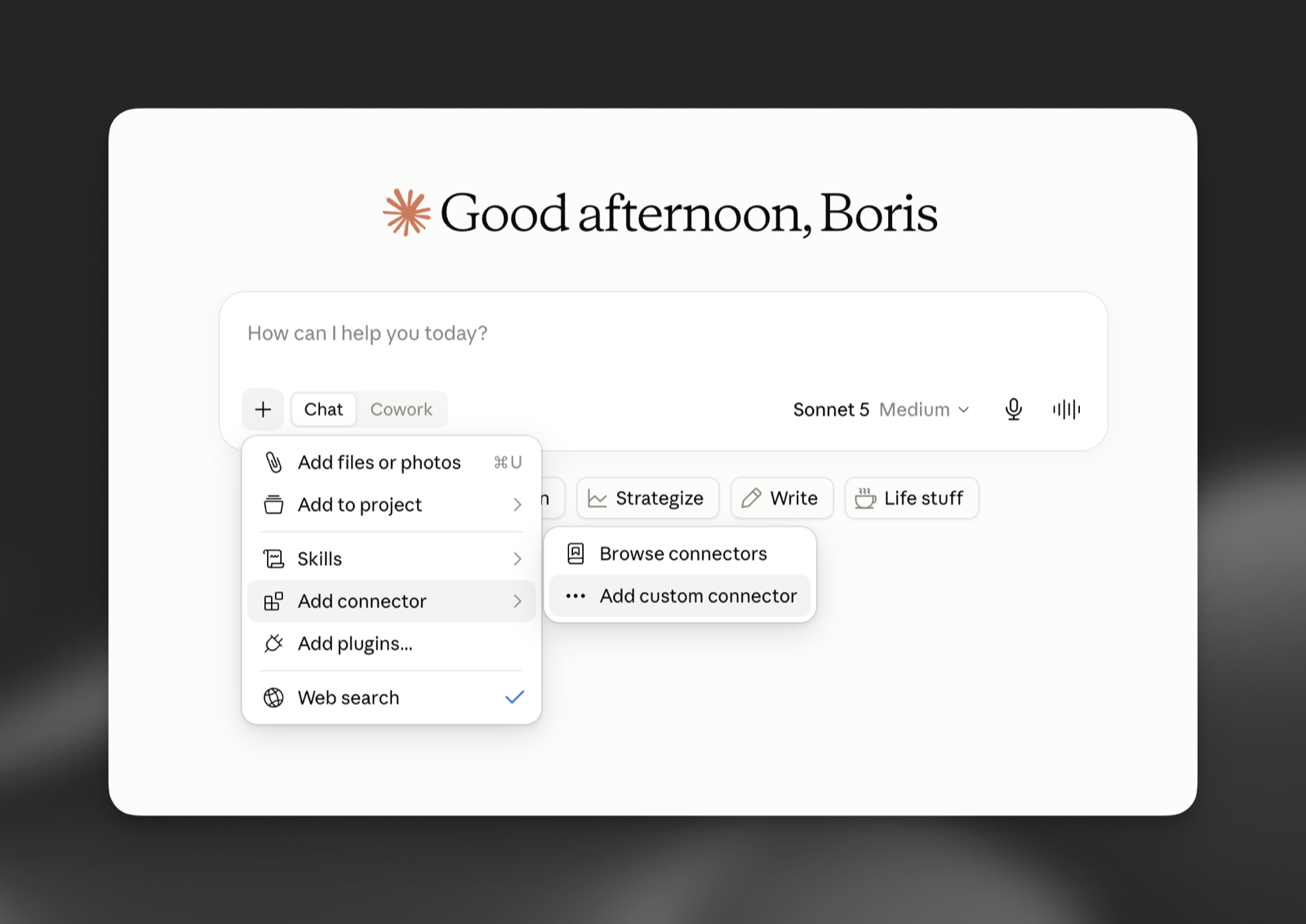
In a new chat, select the + button, then Add connector > Add custom connector. You can also add connectors from Settings > Connectors.
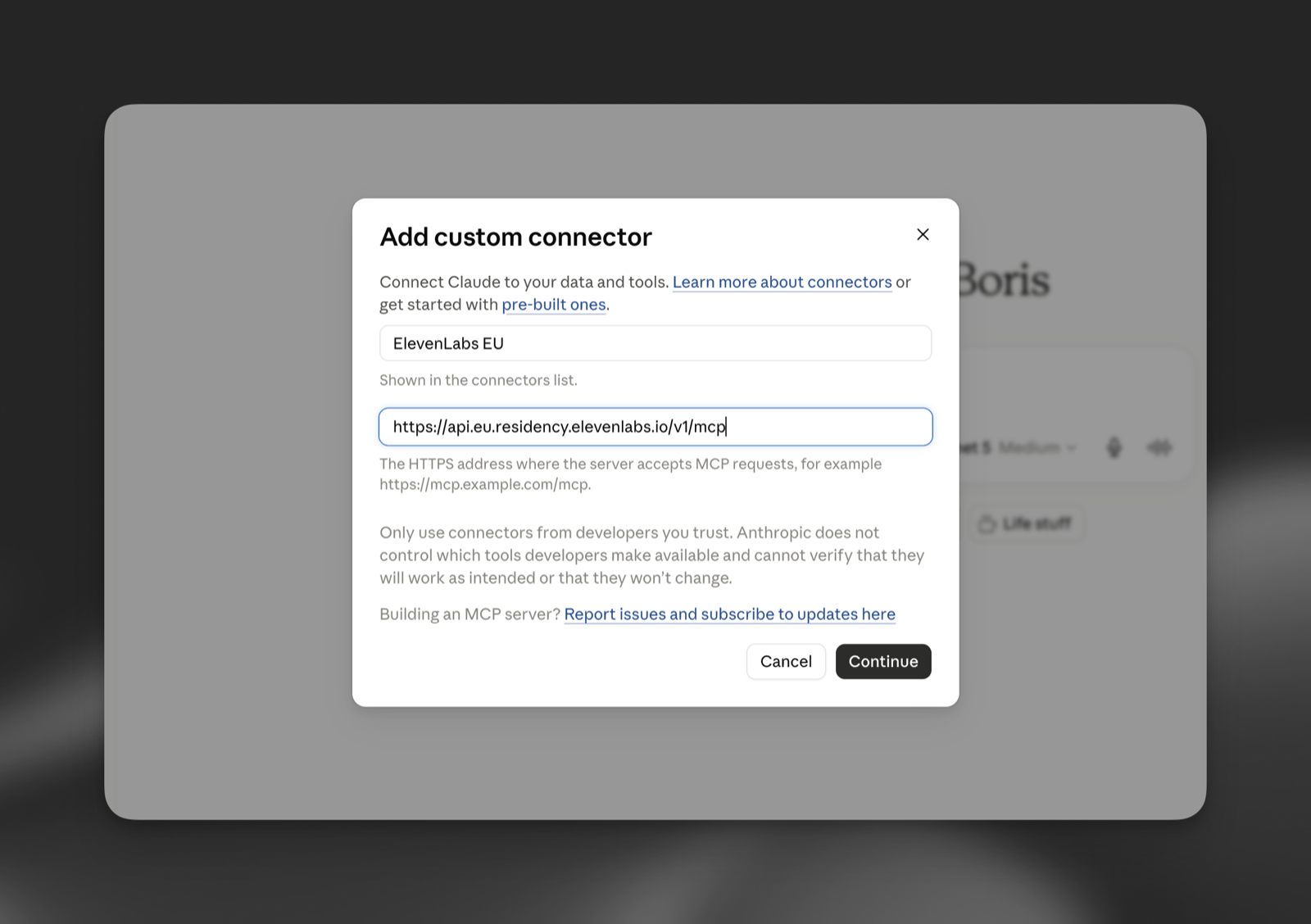
Enter a name and your region's URL
Name the connector so the region is clear, for example “ElevenLabs EU”, and enter your region’s MCP server URL. Select Continue.
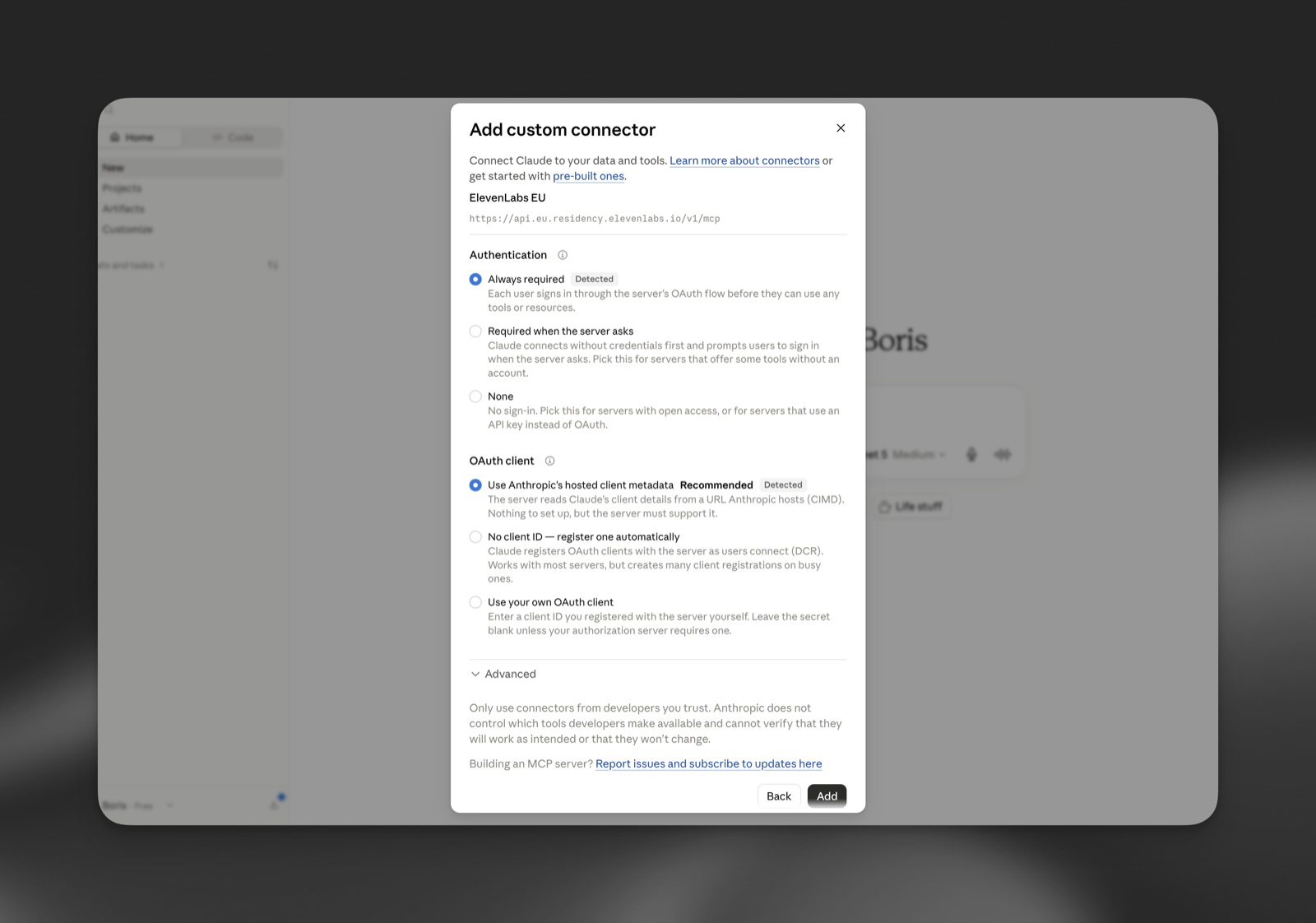
Keep the detected settings
Claude detects the server’s settings automatically: authentication is set to Always required and the OAuth client uses Anthropic’s hosted client metadata. Leave both as detected and select Add.
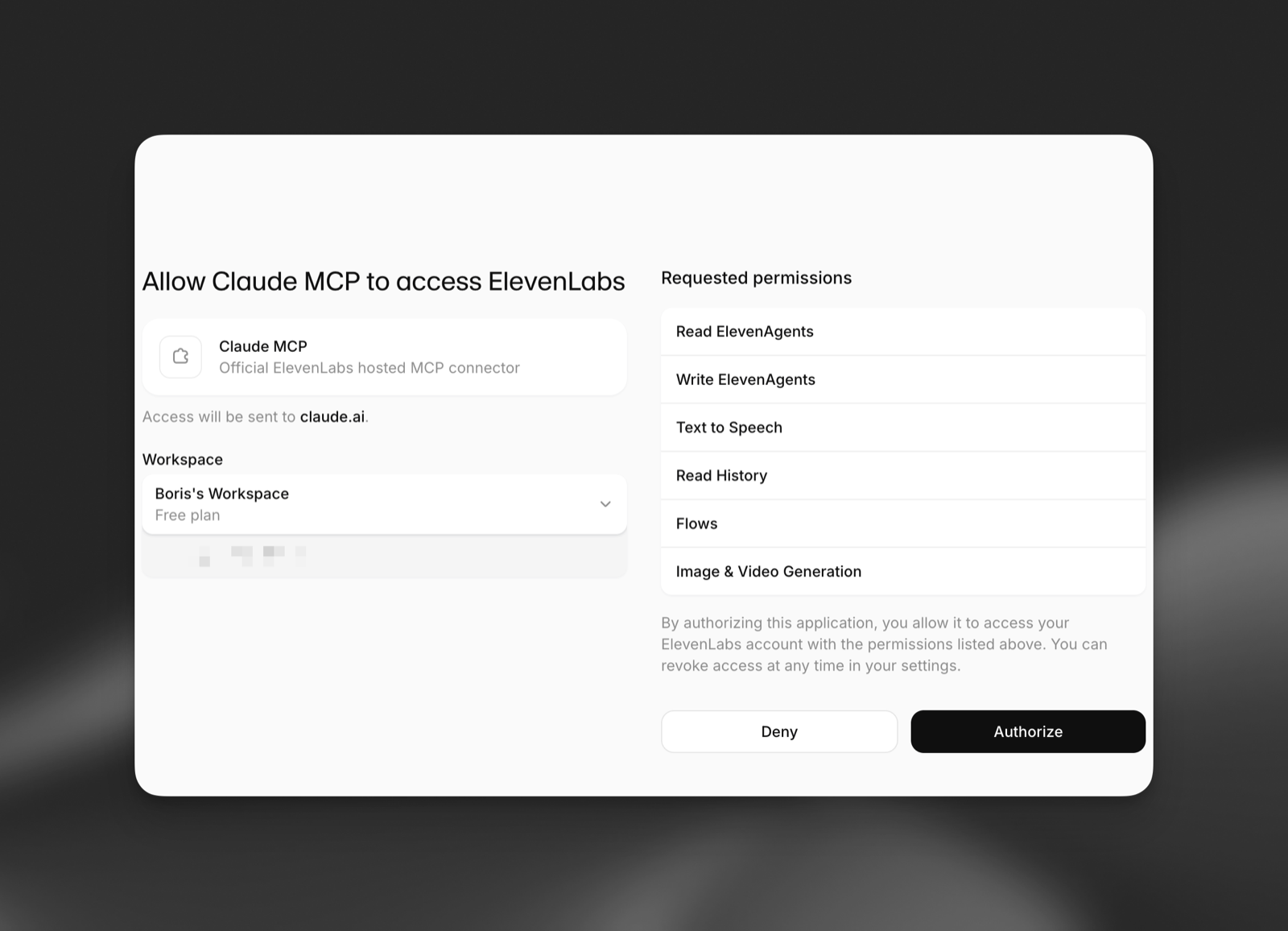
Sign in and authorize
Complete the OAuth flow with your account for that environment. Choose the workspace, review the requested permissions, and select Authorize.
What you can do
Section titled “What you can do”Once connected, your assistant can:
- Create new agents by describing what you want
- Update any agent setting, including the system prompt, voice, language, and first message
- List your agents and inspect or compare their configurations
- Review an agent’s recent conversations and read full transcripts
- Explore the topics your agents’ conversations cover
- Duplicate and delete agents
- Estimate an agent’s expected LLM usage and cost before making changes
- Retrieve an agent’s widget configuration and shareable link
- Check the size of an agent’s knowledge base
- Generate speech audio from text, returned as a short-lived download link
Example prompts
Section titled “Example prompts”Once connected, try prompts like:
- “Create a support agent for my documentation site. It should be friendly, concise, and escalate billing questions.”
- “What would my checkout agent cost per conversation with Gemini 2.5 Flash instead of GPT-4o?”
- “Duplicate my production agent, then change the voice and set the first message to Spanish.”
- “List my agents and tell me which ones still use the default first message.”
- “Generate a sample of my agent’s voice saying our new greeting.”
Permissions
Section titled “Permissions”Two layers control what a connected assistant can do: the permissions you grant to ElevenLabs when you connect, and the tool controls in your MCP client.
ElevenLabs permissions
Section titled “ElevenLabs permissions”When you connect, the OAuth consent screen lists the permissions the assistant is requesting, such as reading and writing agents. The assistant can only perform actions covered by the permissions you approve, and access is limited to the workspace you sign in with. You can revoke the connection at any time from your MCP client or from your ElevenLabs account settings.
Tool controls in your MCP client
Section titled “Tool controls in your MCP client”MCP clients such as Claude let you choose which of the connector’s tools the assistant can use and which require your approval before each call. In Claude, open the ElevenLabs connector’s settings to enable or disable individual tools and to set whether a tool runs automatically or asks for confirmation first.
These controls work at two levels. Workspace administrators can configure the connector and its tools for everyone in their organization, and individual users can apply stricter settings for themselves. A tool disabled by an administrator cannot be re-enabled by an individual user.
Security
Section titled “Security”- Access is scoped by OAuth permissions covering ElevenAgents read and write operations and Text to Speech.
- Deleting an agent is destructive. Review tool calls in your MCP client before approving them, and restrict write access to workspace members who need it.