Transfer to number
Overview
Section titled “Overview”The transfer_to_number system tool allows an ElevenLabs agent to transfer the ongoing call to a specified phone number or SIP URI when certain conditions are met. This enables agents to hand off complex issues, specific requests, or situations requiring human intervention to a live operator.
This feature supports transfers via Twilio and SIP trunk numbers. When triggered, the agent can provide a message to the user while they wait and a separate message summarizing the situation for the human operator receiving the call.
Transfer Types
Section titled “Transfer Types”The system supports three types of transfers:
- Conference Transfer: Default behavior that calls the destination and adds the participant to a conference room, then removes the AI agent so only the caller and transferred participant remain. When using the native Twilio integration, supports a warm transfer message (
agent_message) read to the human operator. - Blind Transfer: Transfers the call directly to the destination without a warm transfer message to the human operator. Preserves the original caller ID. Only available when the agent's phone number is imported via the native Twilio integration.
- SIP REFER Transfer: Uses the SIP REFER protocol to transfer calls directly to the destination. Works with both phone numbers and SIP URIs, but only available when using SIP protocol during the conversation and requires your SIP Trunk to allow transfer via SIP REFER. Does not support warm transfer messages.
Purpose: Seamlessly hand off conversations to human operators when AI assistance is insufficient.
Trigger conditions: The LLM should call this tool when:
- Complex issues requiring human judgment
- User explicitly requests human assistance
- AI reaches limits of capability for the specific request
- Escalation protocols are triggered
Parameters:
reason(string, optional): The reason for the transfertransfer_number(string, required): The phone number to transfer to (must match configured numbers)client_message(string, required): Message read to the client while waiting for transferagent_message(string, required): Message for the human operator receiving the call
Function call format:
{
  "type": "function",
  "function": {
    "name": "transfer_to_number",
    "arguments": "{\"reason\": \"Complex billing issue\", \"transfer_number\": \"+15551234567\", \"client_message\": \"I'm transferring you to a billing specialist who can help with your account.\", \"agent_message\": \"Customer has a complex billing dispute about order #12345 from last month.\"}"
  }
}Implementation: Configure transfer phone numbers and conditions. Define messages for both customer and receiving human operator. Works with both Twilio and SIP trunking.
Numbers that can be transferred to
Section titled “Numbers that can be transferred to”Human transfer supports transferring to external phone numbers using both SIP trunking and Twilio phone numbers.
Enabling human transfer
Section titled “Enabling human transfer”Human transfer is configured using the transfer_to_number system tool.
Add the transfer tool
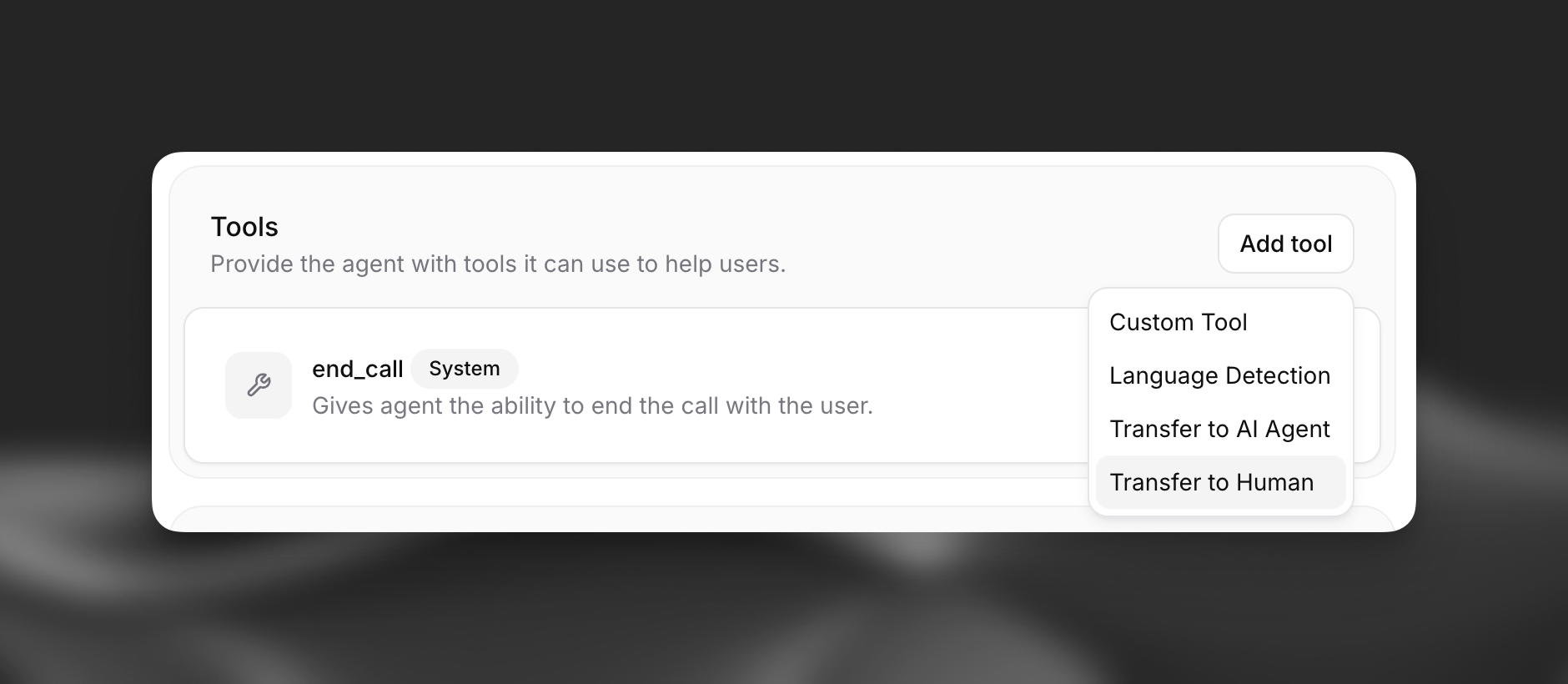
Section titled “Add the transfer tool”Enable human transfer by selecting the transfer_to_number system tool in your agent's configuration within the Agent tab. Choose "Transfer to Human" when adding a tool.
Configure tool description (optional)
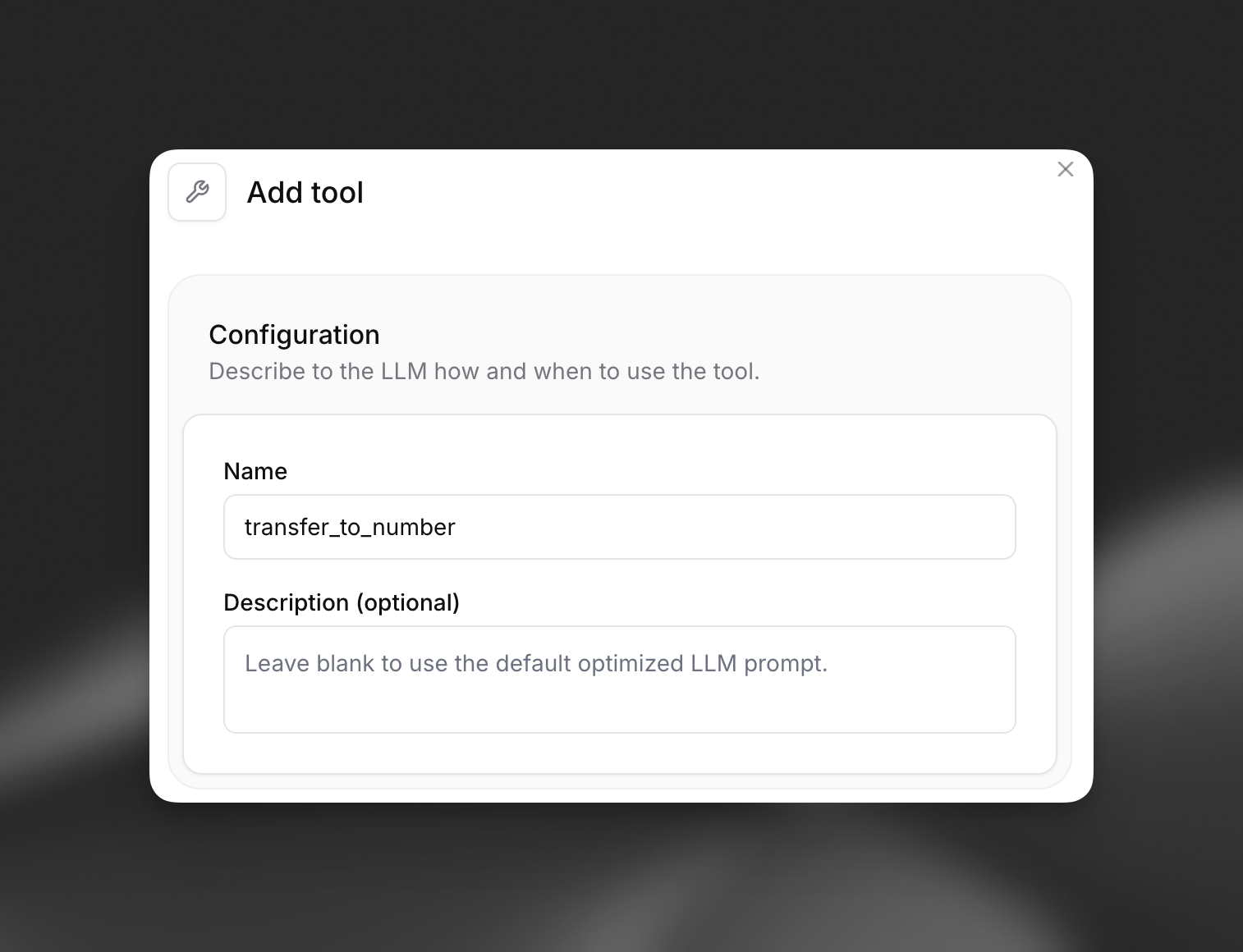
Section titled “Configure tool description (optional)”You can provide a custom description to guide the LLM on when to trigger a transfer. If left blank, a default description encompassing the defined transfer rules will be used.
Define transfer rules
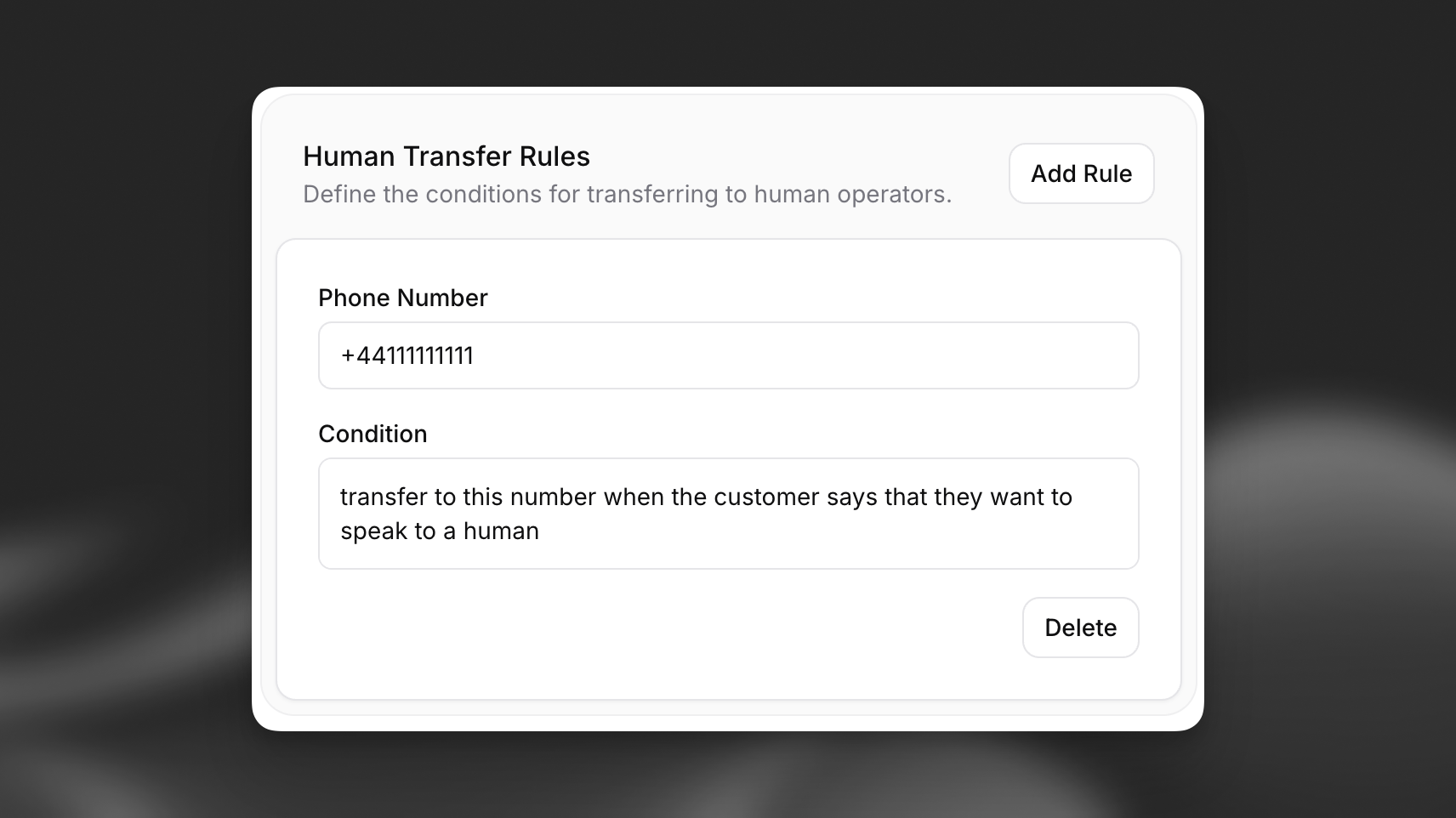
Section titled “Define transfer rules”Configure the specific rules for transferring to phone numbers or SIP URIs. For each rule, specify:
- Transfer Type: Choose between Conference (default), Blind, or SIP REFER transfer methods
- Number Type: Select Phone for regular phone numbers or SIP URI for SIP addresses
- Phone Number/SIP URI: The target destination in the appropriate format:
- Phone numbers: E.164 format (e.g., +12125551234)
- SIP URIs: SIP format (e.g., sip:1234567890@example.com)
- Condition: A natural language description of the circumstances under which the transfer should occur (e.g., "User explicitly requests to speak to a human", "User needs to update sensitive account information").
The LLM will use these conditions, along with the tool description, to decide when and to which destination to transfer.
Configure custom SIP REFER headers (optional)
Section titled “Configure custom SIP REFER headers (optional)”When using SIP REFER transfers, you can include custom SIP headers to pass additional information to the receiving system.
For each custom header, specify:
- Header Name: The SIP header name (e.g.,
X-Customer-ID,X-Priority) - Header Value: The header value, which can be static text or include dynamic variables
Configure User-to-User Information (UUI) (optional)
Section titled “Configure User-to-User Information (UUI) (optional)”SIP REFER transfers can carry User-to-User Information (UUI), a small payload delivered to the receiving platform (for example Talkdesk or Genesys Cloud) in the User-to-User parameter of the Refer-To header. UUI is only sent on SIP REFER transfers to a SIP URI destination; phone-number (tel:) destinations do not carry it.
Configure UUI per transfer rule with the uui object:
data: The payload to send, as plaintext. ElevenLabs hex-encodes it and appends;encoding=hex. Can be static text or include dynamic variables. Maximum 256 bytes (UTF-8), enforced after dynamic variables are substituted — for plain ASCII that is 256 characters, fewer for multi-byte characters.protocol_discriminator: A single hex octet, for example04. Include it for platforms that strip the first octet of the payload; omit it for platforms that pass the payload through.protocol_discriminator_mode:prefix(default) prepends the octet, producing04<hex>;encoding=hex.pd_parameteradds it as a separate parameter, producing<hex>;pd=04;encoding=hex.
To receive UUI on inbound SIP calls, no configuration is required. When an incoming INVITE contains a User-to-User header, its value is exposed to the agent as the {{sip_uui_raw}} and {{sip_uui_data}} dynamic variables. See the SIP reference.
Configure post-dial digits (optional)
Section titled “Configure post-dial digits (optional)”Post-dial digits are DTMF tones that are relayed after the phone connects to the transfer destination. This is useful for entering extensions or navigating IVR (Interactive Voice Response) menus automatically.
For each transfer rule, you can specify a post_dial_digits string containing:
- Digits (
0-9): Standard DTMF tones w: 0.5 second delayW: 1 second delay*and#: Special DTMF tones
For example, ww1234 waits 1 second after the call connects, then dials extension 1234.
API Implementation
Section titled “API Implementation”You can configure the transfer_to_number system tool when creating or updating an agent via the API (Create agent, Update agent). The tool allows specifying messages for both the client (user being transferred) and the agent (human operator receiving the call).
from elevenlabs import AgentConfig, ConversationalConfig, ElevenLabs

elevenlabs = ElevenLabs(api_key="YOUR_API_KEY")

# Define transfer rules
transfer_rules = [
    {
        "transfer_destination": {"type": "phone", "phone_number": "+15551234567"},
        "condition": "When the user asks for billing support.",
        "transfer_type": "conference",
        # Wait 1s, then dial extension 1234 (native Twilio only)
        "post_dial_digits": {"type": "static", "value": "ww1234"},
    },
    {
        "transfer_destination": {"type": "phone", "phone_number": "+15559876543"},
        "condition": "When the user asks to speak to a human.",
        # Native Twilio integration only, preserves caller ID, no warm transfer message
        "transfer_type": "blind",
    },
    {
        "transfer_destination": {"type": "sip_uri", "sip_uri": "sip:support@example.com"},
        "condition": "When the user requests to file a formal complaint.",
        "transfer_type": "sip_refer",
        "custom_sip_headers": [
            {"type": "static", "key": "X-Department", "value": "complaints"},
            {"type": "static", "key": "X-Priority", "value": "high"},
            # Use "dynamic" to read the value from a dynamic variable
            {"type": "dynamic", "key": "X-Customer-ID", "value": "{{customer_id}}"},
        ],
        "uui": {
            "data": "account_id={{customer_id}}",
            "protocol_discriminator": "04",           # Genesys Cloud; omit for Talkdesk
            "protocol_discriminator_mode": "prefix",  # or "pd_parameter"
        },
    },
]

response = elevenlabs.conversational_ai.agents.create(
    conversation_config=ConversationalConfig(
        agent=AgentConfig(
            first_message="Hi, how can I help you today?",
            prompt={
                "prompt": "You are a helpful assistant.",
                "built_in_tools": {
                    "transfer_to_number": {
                        "type": "system",
                        "name": "transfer_to_number",
                        # Optional custom description
                        "description": "Transfer the user to a human operator based on their request.",
                        "params": {
                            "system_tool_type": "transfer_to_number",
                            "transfers": transfer_rules,
                        },
                    }
                },
            },
        ),
    ),
)

# Note: When the LLM decides to call this tool, it needs to provide:
# - transfer_number: The phone number to transfer to (must match one defined in rules).
# - client_message: Message read to the user during transfer.
# - agent_message: Message read to the human operator receiving the call (native Twilio integration only, not used for blind transfers or SIP).import { ElevenLabsClient } from "@elevenlabs/elevenlabs-js";
const elevenlabs = new ElevenLabsClient({
apiKey: "YOUR_API_KEY",
});
await elevenlabs.conversationalAi.agents.create({
conversationConfig: {
agent: {
firstMessage: "Hi, how can I help you today?",
prompt: {
prompt: "You are a helpful assistant.",
builtInTools: {
transferToNumber: {
type: "system",
name: "transfer_to_number",
description: "Transfer the user to a human operator based on their request.", // Optional custom description
params: {
systemToolType: "transfer_to_number",
transfers: [
{
transferDestination: { type: "phone", phoneNumber: "+15551234567" },
condition: "When the user asks for billing support.",
transferType: "conference",
// Wait 1s, then dial extension 1234 (native Twilio only)
postDialDigits: { type: "static", value: "ww1234" },
},
{
transferDestination: { type: "phone", phoneNumber: "+15559876543" },
condition: "When the user asks to speak to a human.",
// Native Twilio only, preserves caller ID, no warm transfer message
transferType: "blind",
},
{
transferDestination: { type: "sip_uri", sipUri: "sip:support@example.com" },
condition: "When the user requests to file a formal complaint.",
transferType: "sip_refer",
customSipHeaders: [
{ type: "static", key: "X-Department", value: "complaints" },
{ type: "static", key: "X-Priority", value: "high" },
// Use "dynamic" to read the value from a dynamic variable
{ type: "dynamic", key: "X-Customer-ID", value: "{{customer_id}}" },
],
uui: {
data: "account_id={{customer_id}}",
protocolDiscriminator: "04", // Genesys Cloud; omit for Talkdesk
protocolDiscriminatorMode: "prefix", // or "pd_parameter"
},
},
],
},
},
},
},
},
},
});
// Note: When the LLM decides to call this tool, it needs to provide:
// - transfer_number: The phone number to transfer to (must match one defined in rules).
// - client_message: Message read to the user during transfer.
// - agent_message: Message read to the human operator receiving the call (native Twilio integration only, not used for blind transfers or SIP).